Saturday, December 8, 2012
Tsunnamis and its Dangers
Tsunami is one of the most powerful and most devastating forces in nature. Tsunami has been known to human population settled around coastal areas for thousands and thousands of years, but the first written testimonies date from few hundred years BCE. Although Tsunami has different names in different parts of the world, the word Tsunami comes from Japanese language, and is widely accepted as the name for this natural phenomenon through the world.
The devastating force of tsunami became widely known after 2004 Indian Ocean tsunami, when over 230,000 people were killed in 14 countries. There are a few reasons why tsunamis are so destructive; first of all, tsunami is mostly generated by earthquakes, volcanic eruptions, and landslides at the bottom of the oceans, and therefore, it is very often unnoticed because the huge volume of water is displaced, many hundred meters or even kilometers under the surface. As a consequence, a wave is formed with a very long wavelength (sometimes hundreds of kilometers long) and a very small wave height, and that is why it often travels hundreds of kilometers virtually unnoticed as it forms a very small wave on the surface, most of the time about only 30 centimeters. That is why the ships and boats sailing of shore cannot recognize such a wave as a sign of tsunami and it often happened that fisherman came ashore only to find out that their villages literally do not exist anymore, while they haven’t noticed anything conspicuous during their time at the sea. However, tsunami wave dramatically grows in height as it reaches shallower water. Although the wave sometimes travels at 800 kilometers per hour or even more, it abruptly slows down when it reaches shallow waters decreasing its speed below 80 kilometers per hour. The clash with coast also diminishes tsunami’s wavelength to less than 20 kilometers, but its wave height takes over the overall power of the tsunami wave as it increases up to 14-30 meters high or more. The highest recorded wave was 524 meters; it was caused by a giant land slide in Alaska in 1958. Another reason why tsunamis are so devastating is that they can travel huge distances and reach many shores and countries, as it happened in 2004 Indian Ocean tsunami, or when an earthquake occurred in Alaska in 1946 and 14 meters tsunami caused by it reached Hawaii. Such tsunamis caused by so cold mega thrust earthquakes are known as telletsunamis because they can travel across the entire oceans. The third reason why tsunamis are so destructive is that not only that the huge wall of water smashes the shore with unimaginable force, but it also drains of the land almost immediately carrying with it an enormous amount of debris consisting of trees, cars, and entire houses, producing a deadly smashing force which sweeps everything in its path. Unfortunately, most people are killed and drowned by the debris of the draining wave.
Although most tsunamis are caused by earthquakes, landslides, and volcanic eruptions, they are sometimes triggered by glacier calving and sometimes even by meteorites and nuclear tests. Most tsunamis, almost 80% occur in the Pacific Ocean; other 20% occur mostly in Indian Ocean, but they sometimes happen in the Atlantic Ocean, in the seas, and even in the big lakes. Although people were trying for centuries to predict tsunamis, and although the 2004 Indian Ocean tsunami raised the necessity to predict such a brutal force, it is not always possible to predict tsunamis, even when the location of an earthquake is detected. Fortunately, there are some, although short notice, signs which announce tsunami and the most obvious one is a drawback which is a very unusual phenomenon consisting of coastal waters drawing back to the ocean, reseeding dramatically and exposing hundreds of meters of shore line which is normally submerged in water. Drawbacks are even accompanied by an eerie sucking sound as the ocean literally sucks the huge amount of coastal water. Sometimes, people, especially tourists, got killed because they are driven by curiosity to explore the exposed shores. Little do they know that tsunami proceeds almost immediately after the drawback. After the 2004 Indian Ocean tsunami, seismologists, oceanographers and geologists started to conceive a more efficient warning and predicting system hoping it will provide that in future there will be no more massive causalities. The system provides warnings immediately after the earthquake, which should give enough time for the coastal guards to warn the inhabitants to promptly leave the shore line area, saving their lives. Such warning systems are mainly based on the bottom pressure sensors attached to buoys which constantly monitor the pressure over the overlying water column. It is interesting to notice that some animals apparently have the ability to immediately predict earthquakes and tsunamis, especially elephants who normally communicate trough low wave or infrasound, so it is quite possible that they can detect the deep underwater rumbling sound which human ear cannot reach. Even though such animal ability cannot be used as a warning system there are many reports in the 2004 Indian Ocean earthquake that some animals escaped to the higher ground minutes before the tsunami.
Hopefully, in the future, technology will provide an efficient warning system which will enable people from coastal area to evacuate in advance and save their lives.

Monday, November 12, 2012
Expirimenting with Iodine
During the last week in Science class we have started learning about chemical changes and how chemical chages are shown in expiriments. We learned what is a difference between a physical chnage and a chemical change. For example a example of a physical chnage is the changing of water from Ice to liquid water and to evaporation. An example of a chemical change could be when fine metal comes in contact with water it will start rusting, this is a chemical change. After this, we have started a class lab which involved of mesuring vitamin C in certain objects. We used Iodine to determine how much vitamin C is in a certain object. Know when we have skilled this lab we are beggining to create our own lab which will include vitamin c an measuring of how much vitamin c will a certain object have in it, to deterime this we will use i our labs Iodine. For example my lab will be on based does a mandarine or a normal orange which one has more vitamin C in it.
Monday, October 22, 2012
Color Changing by Water
Today in Science class we have explored the color changing by using water. The materials we used were pieces of paper, markers, and containers filled with water.
The procedure was, first we had to fill up the containers with water but just a little (Probably about a centimeter or 2) When we got done with that we took small pieces of paper and drew a dot of a random color that we had. Afterwards, we put that piece of paper into that container, but in a special position we have placed the piece of paper so the water climbs on it. After we have placed the paper we take out the paper and observe what happened. I observed that the dot had turned into a big blob and as well it changed colors. For example i have put a green dot on the piece of paper and when I took out of the water it turned into a green, yellow, blue blob. This is because the color green was made for the blue and yellow hue. Thus, means that yellow and blue are more of polar colors.
Wednesday, October 17, 2012
Colors Changing
Today in Science class we have explored the color changing by using water. The materials we used were pieces of paper, markers, and containers filled with water.
The procedure was, first we had to fill up the containers with water but just a little (Probably about a centimeter or 2) When we got done with that we took small pieces of paper and drew a dot of a random color that we had. Afterwards, we put that piece of paper into that container, but in a special position we have placed the piece of paper so the water climbs on it. After we have placed the paper we take out the paper and observe what happened. I observed that the dot had turned into a big blob and as well it changed colors. For example i have put a green dot on the piece of paper and when I took out of the water it turned into a green, yellow, blue blob. This is because the color green was made for the blue and yellow hue. Thus, means that yellow and blue are more of polar colors.
Saturday, September 1, 2012
Women Have a Stronger Immune System Then Men
Statistics show that in humans, and in other mammals as well, females live longer then males and are more able to fight off shock episodes such as infection, sepsis, or trauma. The researchers tried to find the explanation for this phenomenon and they recently concluded that this is due to the X-chromosome, whose biological mechanisms have a strong impact on individual's genes. That is because the X- chromosome contains 10% of all micro RNAs which have important functions in immunity and cencer. Micro RNA is tiny strands of ribonucleic acid, which together with DNA, and proteins make up the three major macromolecules that are essential for all known forms of life. The role of micro RNAs encoded on the X- chromosome is such that it obviously impacts immune system in a way that is less likely to develop cancer and is more able to fight off shock episodes. This leaves males at an immunological disadvantage as a male has only one X-chromosome and Y- chromosome contains fewer genes.
Monday, June 4, 2012
A World in a Bottle
Lab Report
Guiding Question: How do organisms survive in a closed ecosystem?
Hypothesis: I am hypothesizing that the plants will grow around 5 inches in 10 days.
My hypothesis were almost correct. The plant grew 4 inches in 11 days.
Materials:
• Soil
• Sand
• Cotton
• Seeds
• Water
• Plastic bottles
• Moss
Process: First my group and I have got two plastic bottles and cut the top of the bottle and put soil in the bottle, afterwards, we have planted seeds in the soil and sprinkled some water so it can grow faster. In the other bottle we cut the bottle, put the soil, planyed seeds and we have put cotton . We did this so we can see which one will grow faster and better.
Variables: In our lab the controlled variables were, the soil, the seeds , and the water. The manipulated variables were cotton, and moss.
Data collection:
Table
Data collection: In our lab we have measured the height of the plant daily, so that we can see how much did the plant grow from the day before we measured in inches. Our controlled variable was the height.
Content Review
In this lab the biotic factors were the seeds ,the soil , water. The abiotic factors were: cotton, moss, and sand.
2. The factors all have entered the terrarium, cotton for example helped us by growing the plants much faster.
3. A plant eating insect would be able to survive but for a short period of time because it will eat the plant in just few days.
4. It differs by: we planted the plants in a bottle, and we used cotton and moss and sand which differs a lot from the ecosystem in the world. Plants are mostly planted in soil in the ground.
Conclusion: The Planting in a bottle with abiotic factors proved true. This type of planting worked a great deal. The plants grew over 10 inches this proved that this method could be used for a shorter period of time, because the roots wont have any more room to grow in the bottle.
Further Inquiry: I am questioning, would the plants able to survive more time in the bottle even though their roots are getting bigger.
Sound Waves Lab Report
Luka Ilic
5/25/2012
Mrs. Medenica Science
International School of Belgrade
Sound Waves Lab Report
Guiding Question: Through which objects do the sound waves travel faster or slower, do the vibrations through an object depend on the density of the object?
Hypothesis: The sound will travel faster through less dense objects than through the denser objects, causing bigger and smaller vibrations, respectively.
Variables: Controlled variable will be the tuning fork. Manipulated variable will be the various types of solids through which the sound will be traveling, causing vibrations. The Responding variable will be the vibrations that have traveled through the objects.
Materials
• Tuning fork
• Various surfaces which will be tested.
Procedure:
First I will have to get my materials. This includes the tuning fork and the surfaces to be tested.
Tap the tuning fork on various surfaces such as a desk, wall, chair, locker, etc.
Measure the time of the vibrations in the tuning fork.
Record and analyze the data of vibrations distributed through the objects listed above.
Data Table
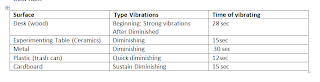 Data Analysis: During Experimenting I have noticed that the less dense an object is he easier the vibrations travel through it. On the other hand, vibrations travel slower through the denser objects, thus, the vibrations are more difficult to hear. I have recorded how much tome does it take for a vibration to travel through the objects listed above, and can say that the vibrations have traveled the longest through the metal plate. This is because the experimented surface in this case the metal plate has a very low density. While, the vibrations traveled the fastest through plastic. Since the experimented plastic was thick, the vibrations stopped traveling at 12 seconds. What I have noticed is that the thicker the object, the slower the vibrations will travel through it. I also recorded the types of vibrations. The diminishing vibrations were fading away all the time, the sustain diminishing vibrations were staying on a certain point for a small period of time but again afterwards started fading away.
Further Inquiry:
During experimenting I came up with some questions related to this experiment. I thought if vibrations could be measured, in other worded if there is a typical method that is used for measuring vibrations. Regarding this I also came up with a question of how do vibrations stop and why do they stop at a certain point.
Conclusion: As a result of this. Vibrations are basically, sound waves that can travel through any object. In this experiment the manipulated variable were the various objects that the tuning fork was tested on. Therefore, this meant that the solids were not all having the same amount of mass; instead, all of the solids that have been tested had different amounts of mass in them. This is why I had to measure the time of the vibrations traveling through an object. Vibrations ca travel fast and make big vibrations through an object, or they could travel slowly and make very little vibrations through an object. All of the depends on the density of an object. Since the vibrations are sound waves they will take up all of the area that is given to them to distribute their wave’s trough, just like water waves.
Data Analysis: During Experimenting I have noticed that the less dense an object is he easier the vibrations travel through it. On the other hand, vibrations travel slower through the denser objects, thus, the vibrations are more difficult to hear. I have recorded how much tome does it take for a vibration to travel through the objects listed above, and can say that the vibrations have traveled the longest through the metal plate. This is because the experimented surface in this case the metal plate has a very low density. While, the vibrations traveled the fastest through plastic. Since the experimented plastic was thick, the vibrations stopped traveling at 12 seconds. What I have noticed is that the thicker the object, the slower the vibrations will travel through it. I also recorded the types of vibrations. The diminishing vibrations were fading away all the time, the sustain diminishing vibrations were staying on a certain point for a small period of time but again afterwards started fading away.
Further Inquiry:
During experimenting I came up with some questions related to this experiment. I thought if vibrations could be measured, in other worded if there is a typical method that is used for measuring vibrations. Regarding this I also came up with a question of how do vibrations stop and why do they stop at a certain point.
Conclusion: As a result of this. Vibrations are basically, sound waves that can travel through any object. In this experiment the manipulated variable were the various objects that the tuning fork was tested on. Therefore, this meant that the solids were not all having the same amount of mass; instead, all of the solids that have been tested had different amounts of mass in them. This is why I had to measure the time of the vibrations traveling through an object. Vibrations ca travel fast and make big vibrations through an object, or they could travel slowly and make very little vibrations through an object. All of the depends on the density of an object. Since the vibrations are sound waves they will take up all of the area that is given to them to distribute their wave’s trough, just like water waves.
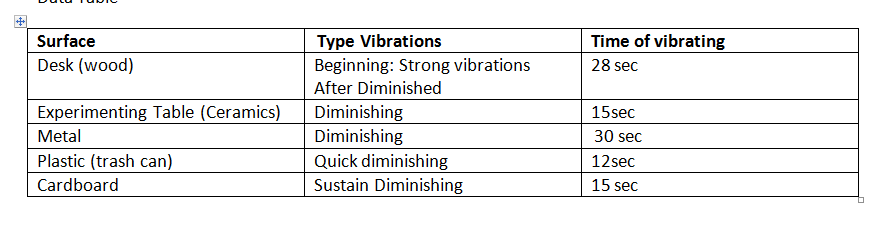 Data Analysis: During Experimenting I have noticed that the less dense an object is he easier the vibrations travel through it. On the other hand, vibrations travel slower through the denser objects, thus, the vibrations are more difficult to hear. I have recorded how much tome does it take for a vibration to travel through the objects listed above, and can say that the vibrations have traveled the longest through the metal plate. This is because the experimented surface in this case the metal plate has a very low density. While, the vibrations traveled the fastest through plastic. Since the experimented plastic was thick, the vibrations stopped traveling at 12 seconds. What I have noticed is that the thicker the object, the slower the vibrations will travel through it. I also recorded the types of vibrations. The diminishing vibrations were fading away all the time, the sustain diminishing vibrations were staying on a certain point for a small period of time but again afterwards started fading away.
Further Inquiry:
During experimenting I came up with some questions related to this experiment. I thought if vibrations could be measured, in other worded if there is a typical method that is used for measuring vibrations. Regarding this I also came up with a question of how do vibrations stop and why do they stop at a certain point.
Conclusion: As a result of this. Vibrations are basically, sound waves that can travel through any object. In this experiment the manipulated variable were the various objects that the tuning fork was tested on. Therefore, this meant that the solids were not all having the same amount of mass; instead, all of the solids that have been tested had different amounts of mass in them. This is why I had to measure the time of the vibrations traveling through an object. Vibrations ca travel fast and make big vibrations through an object, or they could travel slowly and make very little vibrations through an object. All of the depends on the density of an object. Since the vibrations are sound waves they will take up all of the area that is given to them to distribute their wave’s trough, just like water waves.
Data Analysis: During Experimenting I have noticed that the less dense an object is he easier the vibrations travel through it. On the other hand, vibrations travel slower through the denser objects, thus, the vibrations are more difficult to hear. I have recorded how much tome does it take for a vibration to travel through the objects listed above, and can say that the vibrations have traveled the longest through the metal plate. This is because the experimented surface in this case the metal plate has a very low density. While, the vibrations traveled the fastest through plastic. Since the experimented plastic was thick, the vibrations stopped traveling at 12 seconds. What I have noticed is that the thicker the object, the slower the vibrations will travel through it. I also recorded the types of vibrations. The diminishing vibrations were fading away all the time, the sustain diminishing vibrations were staying on a certain point for a small period of time but again afterwards started fading away.
Further Inquiry:
During experimenting I came up with some questions related to this experiment. I thought if vibrations could be measured, in other worded if there is a typical method that is used for measuring vibrations. Regarding this I also came up with a question of how do vibrations stop and why do they stop at a certain point.
Conclusion: As a result of this. Vibrations are basically, sound waves that can travel through any object. In this experiment the manipulated variable were the various objects that the tuning fork was tested on. Therefore, this meant that the solids were not all having the same amount of mass; instead, all of the solids that have been tested had different amounts of mass in them. This is why I had to measure the time of the vibrations traveling through an object. Vibrations ca travel fast and make big vibrations through an object, or they could travel slowly and make very little vibrations through an object. All of the depends on the density of an object. Since the vibrations are sound waves they will take up all of the area that is given to them to distribute their wave’s trough, just like water waves.
Subscribe to:
Posts (Atom)