Monday, June 4, 2012
A World in a Bottle
Lab Report
Guiding Question: How do organisms survive in a closed ecosystem?
Hypothesis: I am hypothesizing that the plants will grow around 5 inches in 10 days.
My hypothesis were almost correct. The plant grew 4 inches in 11 days.
Materials:
• Soil
• Sand
• Cotton
• Seeds
• Water
• Plastic bottles
• Moss
Process: First my group and I have got two plastic bottles and cut the top of the bottle and put soil in the bottle, afterwards, we have planted seeds in the soil and sprinkled some water so it can grow faster. In the other bottle we cut the bottle, put the soil, planyed seeds and we have put cotton . We did this so we can see which one will grow faster and better.
Variables: In our lab the controlled variables were, the soil, the seeds , and the water. The manipulated variables were cotton, and moss.
Data collection:
Table
Data collection: In our lab we have measured the height of the plant daily, so that we can see how much did the plant grow from the day before we measured in inches. Our controlled variable was the height.
Content Review
In this lab the biotic factors were the seeds ,the soil , water. The abiotic factors were: cotton, moss, and sand.
2. The factors all have entered the terrarium, cotton for example helped us by growing the plants much faster.
3. A plant eating insect would be able to survive but for a short period of time because it will eat the plant in just few days.
4. It differs by: we planted the plants in a bottle, and we used cotton and moss and sand which differs a lot from the ecosystem in the world. Plants are mostly planted in soil in the ground.
Conclusion: The Planting in a bottle with abiotic factors proved true. This type of planting worked a great deal. The plants grew over 10 inches this proved that this method could be used for a shorter period of time, because the roots wont have any more room to grow in the bottle.
Further Inquiry: I am questioning, would the plants able to survive more time in the bottle even though their roots are getting bigger.

Sound Waves Lab Report
Luka Ilic
5/25/2012
Mrs. Medenica Science
International School of Belgrade
Sound Waves Lab Report
Guiding Question: Through which objects do the sound waves travel faster or slower, do the vibrations through an object depend on the density of the object?
Hypothesis: The sound will travel faster through less dense objects than through the denser objects, causing bigger and smaller vibrations, respectively.
Variables: Controlled variable will be the tuning fork. Manipulated variable will be the various types of solids through which the sound will be traveling, causing vibrations. The Responding variable will be the vibrations that have traveled through the objects.
Materials
• Tuning fork
• Various surfaces which will be tested.
Procedure:
First I will have to get my materials. This includes the tuning fork and the surfaces to be tested.
Tap the tuning fork on various surfaces such as a desk, wall, chair, locker, etc.
Measure the time of the vibrations in the tuning fork.
Record and analyze the data of vibrations distributed through the objects listed above.
Data Table
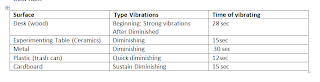 Data Analysis: During Experimenting I have noticed that the less dense an object is he easier the vibrations travel through it. On the other hand, vibrations travel slower through the denser objects, thus, the vibrations are more difficult to hear. I have recorded how much tome does it take for a vibration to travel through the objects listed above, and can say that the vibrations have traveled the longest through the metal plate. This is because the experimented surface in this case the metal plate has a very low density. While, the vibrations traveled the fastest through plastic. Since the experimented plastic was thick, the vibrations stopped traveling at 12 seconds. What I have noticed is that the thicker the object, the slower the vibrations will travel through it. I also recorded the types of vibrations. The diminishing vibrations were fading away all the time, the sustain diminishing vibrations were staying on a certain point for a small period of time but again afterwards started fading away.
Further Inquiry:
During experimenting I came up with some questions related to this experiment. I thought if vibrations could be measured, in other worded if there is a typical method that is used for measuring vibrations. Regarding this I also came up with a question of how do vibrations stop and why do they stop at a certain point.
Conclusion: As a result of this. Vibrations are basically, sound waves that can travel through any object. In this experiment the manipulated variable were the various objects that the tuning fork was tested on. Therefore, this meant that the solids were not all having the same amount of mass; instead, all of the solids that have been tested had different amounts of mass in them. This is why I had to measure the time of the vibrations traveling through an object. Vibrations ca travel fast and make big vibrations through an object, or they could travel slowly and make very little vibrations through an object. All of the depends on the density of an object. Since the vibrations are sound waves they will take up all of the area that is given to them to distribute their wave’s trough, just like water waves.
Data Analysis: During Experimenting I have noticed that the less dense an object is he easier the vibrations travel through it. On the other hand, vibrations travel slower through the denser objects, thus, the vibrations are more difficult to hear. I have recorded how much tome does it take for a vibration to travel through the objects listed above, and can say that the vibrations have traveled the longest through the metal plate. This is because the experimented surface in this case the metal plate has a very low density. While, the vibrations traveled the fastest through plastic. Since the experimented plastic was thick, the vibrations stopped traveling at 12 seconds. What I have noticed is that the thicker the object, the slower the vibrations will travel through it. I also recorded the types of vibrations. The diminishing vibrations were fading away all the time, the sustain diminishing vibrations were staying on a certain point for a small period of time but again afterwards started fading away.
Further Inquiry:
During experimenting I came up with some questions related to this experiment. I thought if vibrations could be measured, in other worded if there is a typical method that is used for measuring vibrations. Regarding this I also came up with a question of how do vibrations stop and why do they stop at a certain point.
Conclusion: As a result of this. Vibrations are basically, sound waves that can travel through any object. In this experiment the manipulated variable were the various objects that the tuning fork was tested on. Therefore, this meant that the solids were not all having the same amount of mass; instead, all of the solids that have been tested had different amounts of mass in them. This is why I had to measure the time of the vibrations traveling through an object. Vibrations ca travel fast and make big vibrations through an object, or they could travel slowly and make very little vibrations through an object. All of the depends on the density of an object. Since the vibrations are sound waves they will take up all of the area that is given to them to distribute their wave’s trough, just like water waves.
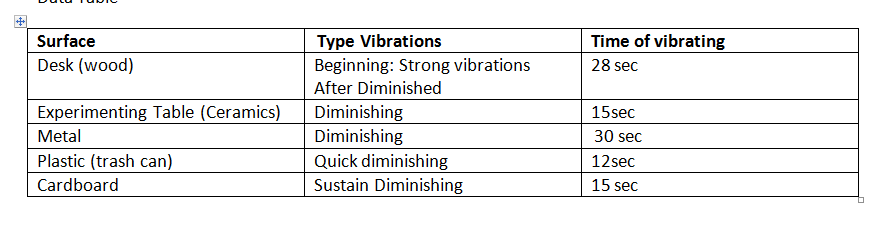 Data Analysis: During Experimenting I have noticed that the less dense an object is he easier the vibrations travel through it. On the other hand, vibrations travel slower through the denser objects, thus, the vibrations are more difficult to hear. I have recorded how much tome does it take for a vibration to travel through the objects listed above, and can say that the vibrations have traveled the longest through the metal plate. This is because the experimented surface in this case the metal plate has a very low density. While, the vibrations traveled the fastest through plastic. Since the experimented plastic was thick, the vibrations stopped traveling at 12 seconds. What I have noticed is that the thicker the object, the slower the vibrations will travel through it. I also recorded the types of vibrations. The diminishing vibrations were fading away all the time, the sustain diminishing vibrations were staying on a certain point for a small period of time but again afterwards started fading away.
Further Inquiry:
During experimenting I came up with some questions related to this experiment. I thought if vibrations could be measured, in other worded if there is a typical method that is used for measuring vibrations. Regarding this I also came up with a question of how do vibrations stop and why do they stop at a certain point.
Conclusion: As a result of this. Vibrations are basically, sound waves that can travel through any object. In this experiment the manipulated variable were the various objects that the tuning fork was tested on. Therefore, this meant that the solids were not all having the same amount of mass; instead, all of the solids that have been tested had different amounts of mass in them. This is why I had to measure the time of the vibrations traveling through an object. Vibrations ca travel fast and make big vibrations through an object, or they could travel slowly and make very little vibrations through an object. All of the depends on the density of an object. Since the vibrations are sound waves they will take up all of the area that is given to them to distribute their wave’s trough, just like water waves.
Data Analysis: During Experimenting I have noticed that the less dense an object is he easier the vibrations travel through it. On the other hand, vibrations travel slower through the denser objects, thus, the vibrations are more difficult to hear. I have recorded how much tome does it take for a vibration to travel through the objects listed above, and can say that the vibrations have traveled the longest through the metal plate. This is because the experimented surface in this case the metal plate has a very low density. While, the vibrations traveled the fastest through plastic. Since the experimented plastic was thick, the vibrations stopped traveling at 12 seconds. What I have noticed is that the thicker the object, the slower the vibrations will travel through it. I also recorded the types of vibrations. The diminishing vibrations were fading away all the time, the sustain diminishing vibrations were staying on a certain point for a small period of time but again afterwards started fading away.
Further Inquiry:
During experimenting I came up with some questions related to this experiment. I thought if vibrations could be measured, in other worded if there is a typical method that is used for measuring vibrations. Regarding this I also came up with a question of how do vibrations stop and why do they stop at a certain point.
Conclusion: As a result of this. Vibrations are basically, sound waves that can travel through any object. In this experiment the manipulated variable were the various objects that the tuning fork was tested on. Therefore, this meant that the solids were not all having the same amount of mass; instead, all of the solids that have been tested had different amounts of mass in them. This is why I had to measure the time of the vibrations traveling through an object. Vibrations ca travel fast and make big vibrations through an object, or they could travel slowly and make very little vibrations through an object. All of the depends on the density of an object. Since the vibrations are sound waves they will take up all of the area that is given to them to distribute their wave’s trough, just like water waves.
Thursday, May 31, 2012
Bowerbirds Rituals
The scientists from Queensland (Australia) published and interesting research on bowerbirds, native to Australia and Papua New Guinea. The birds are well known for their distinctive courtship rituals, which involves males constructing intricate bowers. To decorate the bowers, males collect shiny and brightly colored objects, and the purpose of this creation is to attract females. Because plants such as potato bush have bright purple flowers and green fruit, high numbers of such plants could be found around the bowerbird’s bowers, as birds collect the fruits for display in order to further decorate their bowers. Females are especially attracted to bowers with lots of fruit. What is fascinating is that by collecting the fruits, birds actually grow plants around their constructions rather than building them around locations with high number of the plants. Of course, plants grow around the bowers because the birds gather the fruits and seeds germinate in the ground especially so because bowerbirds keep the area around their bower clear of grass and weeds, creating the soil ideal for germinating and because they sometimes use the same patch of soil for up to ten years. Although it cannot be said that the birds intentionally cultivate the plants, it is still the first time that a species other than humans has been cultivated plants for purpose other than feeding. What is even more fascinating is that the males’ behavior may even cause a change in the appearance of fruits in the same way farmers select the plants with certain features. In this case, because the birds prefer green over the other colors the fruits from plants around the bowers were slightly greener than those found on other plants.
Wednesday, May 30, 2012
Buoy Data Post
During the past month we my class and I have started learning about waves. We had to research about some of the waves that are occurring in the current time. Our teacher provided us with a great link which about the national Buoy data from all of the planet. We have learned that waves are a transfers of energy from one place to another. Waves are formed from energy that is caused on the see floors by tectonic plates. Tectonic plates are big pieces of land on which the worlds continents lie. Tectonic Plates constantly move which causes energy being released and making waves or earthquakes. What I have noticed is that the highest waves are mostly occurring in big oceans such as the Pacific and in the Atlantic and Indian Ocean. This is because of constant moving of tectonic plates. The lowest waves mostly occur in smaller bodies of water such as the Mediterranean sea or around the north Pole. This is one of the causes why Tsunamis form. In the deep water force has been released and has been pushed up at the top. The pressured water travels and until it reaches the sea shore it will form a big wave or a series of waves which is also called tsunami. People are mostly badly affected by these waves. It destroys practically the whole coast. But when the water goes back and makes tide, it leaves fertile silt which is very useful for farming.
Thursday, May 24, 2012
Reflection
During the past unit in Science class, My class and I learned about Astronomy. Some of the things we learned about, how does the motion of the sun and the moon control the water on earth. Tides on Earth control the water level on earth, types of tides are: High tides, meap tides, low tides, and spring tides. Another concept we leaned was about other planets in our Solar System. We also focused about outer planets, not about only our Planet Earth. We learned that there are two types of planets, terrestrial and gass planets. Uranus is a example of a gass planet, while mercury is an example of a telesales planet. Regarding all of this information, the human kind had to do research for a long period of time. The first formal research was in the 15 century when Galileo Galilei have noticed new stars in the sky. Unfortunately, the church in those times was very strong and powerful, but also very straight forward, thus Galileo was banished from the country. Through centuries of research the human race came up with a new technology of space craft and space probes which have been led into space which even today stands in space, which collect data and research for us, n order to have a wider knowledge of the outer space.
Waves Lab
Science Lab
Materials:
• Ripple tank filled up with water
• Pipette
• Styrofoam ball
• Clay sticks
Making Waves
Hypothesis: I hypothesize that, whatever drop is released to fall in the ripple tank it will cause waves which will cover the whole area that is given; in this case it is the ripple tank.
Data Analysis
In the first part of the experiment, where the waves were created by the drop of water released from about 10 height, the waves in the ripple tank behave according to the place where they have been produced: if the wave was created in the center of the ripple tank, it traveled in the form of concentric circles until it reached the edges of the tank. If the waves were produced in the corner of the ripple tank, or in the middle of the ripple tank’s side, they traveled in a form of semi circled ripples, also reaching the very opposite end of the tank. When the waves were created In the corners, center, and at one end of the tank as well, they started to spread either as circles or semi circles; but when they collided they canceled out each other and interrupted each other’s movement.
In the second part of the experiment, interaction between waves and barriers was observed. Whichever wave was produced, it traveled under the floating paper towel or under the Styrofoam ball. However, when a solid object i.e. stick of modeling clay, was placed in the tank the waves started to splash the edges of the clay stick. When the two clay sticks were placed so that a gap of about 2 cm was created, the waves travel as semi circles until they reached the barrier and then split into smaller waves and pass between the barriers using every possible passage to continue their movement. On the other hand, no matter how many Styrofoam balls were placed next to each other on the water surface, and no matter in which part of the tank the waves were created, they would always move under the floating objects lifting them slightly, without interrupting their own movements.
Conclusion
In every phase of the experiment waves showed the ability to travel as far as the end of the tank, even when they were interrupted by solid objects placed shortly apart from each other. Their shape depends of the place of their creation: if they were created in the middle of the tank, they formed full concentric circles, while the ones formed in the corners or at the ends were forming concentric semi circles. Waves have the property to transform the mechanical energy which was used to create them i.e. the energy of a drop of water falling on the water surface is further transform into wave energy. Also, the higher the amplitude and faster the frequency, the bigger/stronger the waves are. As for the waves interaction with each other and in with the solid objects in their paths, when colliding with each other waves tend to cancel out each other’s movements.
Sunday, February 26, 2012
Moon Phases
Guiding Question: What are the phases of the moon? Why do they occur?
Hypothesis: I predict that all of the sides that the moon is turned that the half of thye moon will be lightened.
Materials:
Hypothesis: I predict that all of the sides that the moon is turned that the half of thye moon will be lightened.
Materials:
- One big Styrofoam ball
- one small styrofoam ball
- a toophpick
- a barbaque stick
- a torch
- and a ruler
Subscribe to:
Posts (Atom)